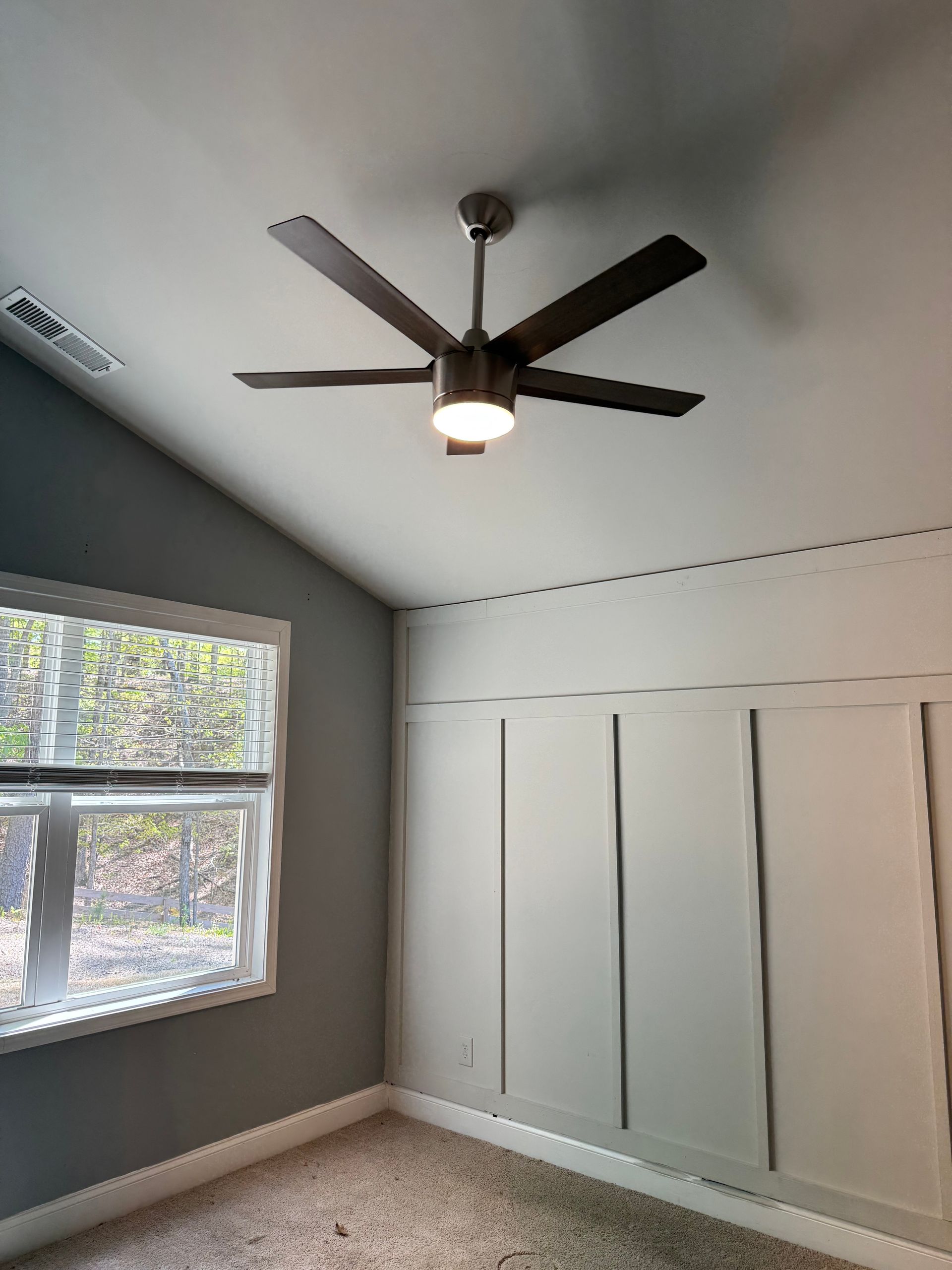

Air Circulation Mounted Securely Overhead
Ceiling Fan Installation & Replacement in Canton for Rooms Without Adequate Airflow
Cherokee County homes benefit from ceiling fans during warm months when moving air reduces reliance on air conditioning, but improper installation creates hazards when fans are mounted to light fixture boxes not rated for rotational weight. Your Home Handyman verifies that junction boxes are fan-rated or replaces them with braced boxes that attach directly to structural framing, then mounts the fan, balances blades to eliminate wobble, and connects light kits when included in the fixture design. After installation, the fan operates quietly without vibration, and you notice improved air circulation that makes rooms feel cooler without adjusting the thermostat.
Electrical circuit verification ensures the existing wiring can handle the fan motor and light load, and junction box replacement involves cutting access to ceiling framing and installing a fan-rated box anchored to a joist or using an expandable brace bar that spans between joists. Blade balancing corrects manufacturing inconsistencies that cause wobble by adding small weights to blade brackets, and light kit connections follow wiring diagrams specific to each fan model.
Schedule an installation assessment to confirm your ceiling structure supports fan mounting and determine whether wiring modifications are needed.
What Changes After Ceiling Fan Installation
Standard ceiling light fixtures in Canton homes near Waleska and Alpharetta do not improve air circulation, and replacing them with ceiling fans requires verifying that the existing electrical box is rated to support both the static weight and rotational forces generated by fan operation. Light fixture boxes are typically rated for 50 pounds of static weight, while fan-rated boxes must support 70 pounds and resist the lateral forces created by blade rotation, and using the wrong box results in the fan pulling loose from the ceiling over time.
Once installation is complete and the fan is balanced, you no longer hear rattling or see visible movement in the mounting canopy, blades rotate smoothly at all speed settings without creating a rhythmic wobble, and light kits provide even illumination without flickering. The fan reduces perceived room temperature by several degrees through air movement, and you can reverse blade direction during winter months to push warm air down from the ceiling.
The service handles standard ceiling heights and vaulted ceilings where downrod length must be adjusted to position blades at least seven feet above the floor, and includes connecting fans to existing circuits or installing new wiring when no overhead electrical source is present. Dimmer switches designed specifically for fan motors are installed when variable speed control is preferred over pull-chain operation, and remote control receivers are integrated when included with the fan model.
Questions Before Starting Your Project
Homeowners planning ceiling fan installations in Canton properties often ask about structural requirements and what determines whether existing wiring can be used without modification.
What determines whether a ceiling box is rated for fan installation?
Fan-rated boxes are marked with a label indicating they meet UL 2282 standards for supporting fan weight and rotation, and are distinguishable from light fixture boxes by their bracing system—either attached directly to a ceiling joist or secured with an expandable metal brace bar that spans between joists.
How is a ceiling fan balanced to eliminate wobble?
Balancing involves running the fan at medium speed to identify which blade creates the most wobble, then attaching small adhesive weights to the top of that blade in different positions until the wobble is minimized, which typically requires testing several weight placements before achieving smooth rotation.
When is new wiring required for ceiling fan installation in Canton homes?
New wiring is required when the room has no existing overhead electrical box, when the current circuit is overloaded and cannot handle additional fan and light load, or when separate wall switches for fan and light control are desired but only one switch leg is currently present.
Why do some ceiling fans make noise during operation?
Noise results from loose blade brackets that vibrate as the fan rotates, motor bearings that lack adequate lubrication, or the fan housing making contact with the mounting bracket due to improper assembly or a junction box that shifts under rotational force.
What ceiling height requires a downrod extension?
Ceilings higher than nine feet require downrod extensions to position fan blades between seven and nine feet above the floor for optimal air circulation, and vaulted ceilings in Cherokee County homes often need angled mounting adapters to keep the fan level despite the sloped ceiling plane.
Your Home Handyman installs ceiling fans in rooms where improved air circulation reduces cooling costs and replaces outdated units that no longer operate quietly or efficiently. Request a consultation to evaluate ceiling structure, existing electrical circuits, and fan placement options based on room dimensions and ceiling configuration.